Bats
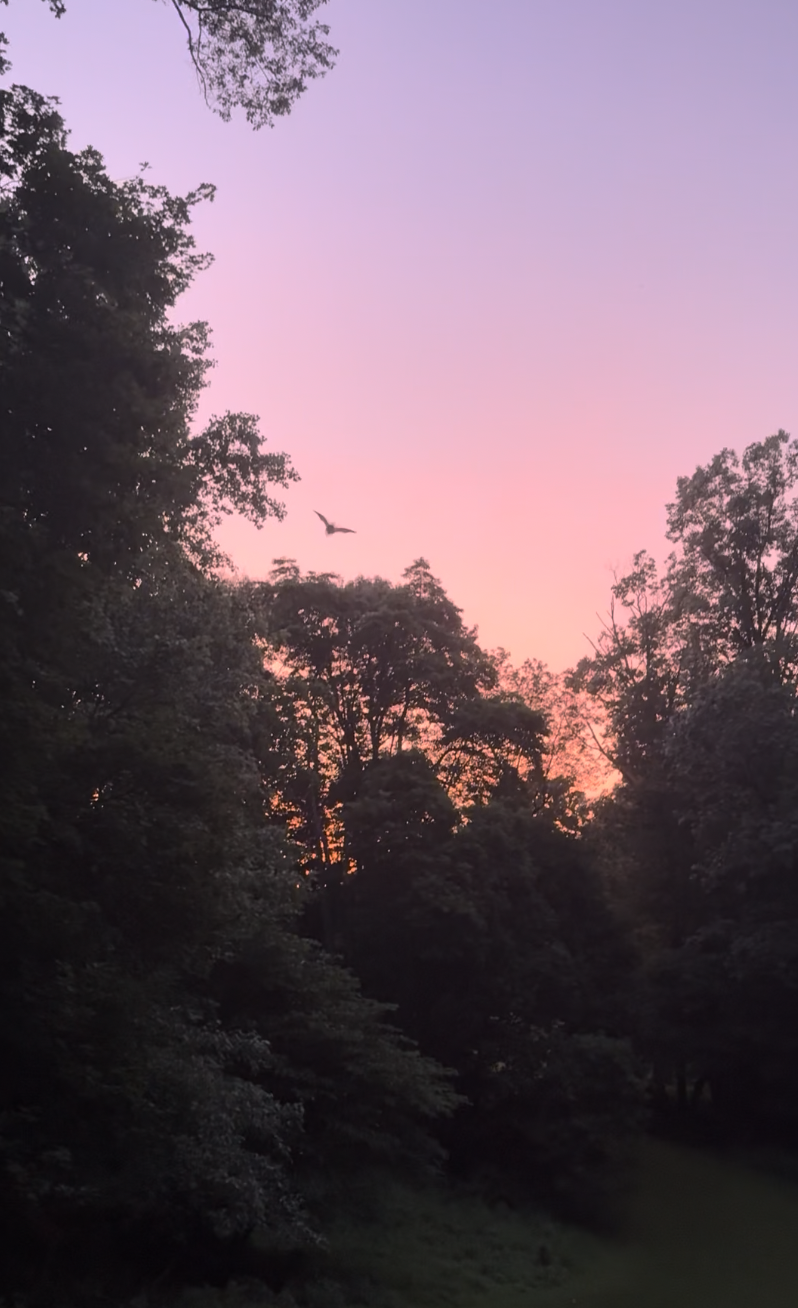
One evening last summer I watched the bats come out in a Philadelphia park.
I could see the blood orange sky visible through the thin skin of their wings. They looped the air between trees, where the sky pooled, diving sideways to catch a single fly. They came out, in this place at least, for only for a short time, a few minutes, it seemed, in that stir of twilight when the insects are transitioning to rest, swarming the sky in a frenzy, this short crescendo into night.
And for an insect like a mosquito, whose lifetime can be measured in hours, was it an exquisite, painless way to die– midflight, into the animal mouth of a bat. I know it takes audacity to say exquisite way to die– to be eaten alive–being human, where being eaten alive is a horrible thought, one associated with torture, given our sturdy bones, dense limbs, the many juicy parts of our bodies that could be gnawed on, could take a while to be broken.
I do think being snapped into the jaws of a shark, crushed handily, or jawily (hehe) – to be immediately of service to such a magnificent creature, to be then excreted into the bottom of the ocean, to become, in short order, a part of the sea ecosystem. (All along, I was afraid of being eaten alive. But there is much mercy in receiving a bite to the jugular!)
I often wonder about insect souls and their swarming, brief lives – do the souls feel the high turnover – is there really a long line to be a human being? And is the line to be an insect faster-moving? To be a part of a body that swarms. I suppose this body, the one that writes now, has its own swarms, the many microbiota that live in the streams of my blood, my stomach, on my skin, under my fingernails. These atmospheres, as suffused with urgency and high-turnover as that dusk sky full of bats and flies.
Insects may be feeling their soul in a way that is closer to the true nature of all things – for your whole world to be within the base of a tree. The collective hand of insects and micro-organisms shapes the world as much as tectonic plates do. It was ancient procaryote mats that shaped climate and precipitated life on earth. A landscape made of their own bodies. It reminds me, this landscape-by-swarming, that I myself am something with texture, to be touched, that I create ecosystems. I used to find the sharp teeth of a slug --which is really one large tooth used as a scraper– unnerving. To think --something sharp in a huge, watery softness, like broken glass in a swimming pool. I have long loved and admired slugs in spite of this quality of theirs.
But now I remember that hardness itself– the calcified structures inside us, cartilaginous, the elbows of life, the canine teeth, the toenails that scratch through skin– is yet another breakthrough in the evolution of life on earth. Sea-dwelling algae, also called diatoms, formed hard protrusions and protective shells as an adaptation that led to new dynamics between beings, 270 million years ago. Organisms could now prick each other, and break each other down, and protect themselves against attack. They grouped together for survival. The origin of social infrastructure and the origin of bones may be the same.
I digress… the bats... I felt in awe of these sky-faring mammals who had evolved out of a series of accidental and intrepid leaps into thin air by their mammal ancestors. I felt my fur in common with theirs, I felt their warm blooded bodies flinging through the sky. Their bones and teeth who share a distant ancestor with algae in the ocean. I felt so proud to know them. They caught the mosquitos hovering around my head. Perhaps the bats ate a bit of my blood for dinner.