Yarrow here and there
I visited Ireland for the first time this October, flying through the night from Philly to Dublin. When I arrived it was 11 in the morning – rainy and warm. I had a few hours until my train to Westport. Dublin seemed coated in a gray film that muted colors and sounds. It felt like looking in on an indoor swimming pool through a glass window.
This was not a place my ancestors knew very well. They knew the west coast of Ireland, several hundred miles away.
I stood in line behind two older Irish women asking for directions from a man at the train ticket counter, and in gratitude, she said "I'll say one for you," and made the sign of the cross over herself. I hadn't seen someone who could be my grandmother make a blessing so casually, with such sincerity, in a long time.
The man who received the blessing told me to drop my luggage at a place "behind a red door" that ultimately appeared to be someone's living room. I paid the attendant and walked on. The air smelled lovely – like the air above a river that has been churned and cleansed by the passage of ionized water. One thing about a rainy place is that the air is being filled and emptied of matter constantly, which feels like breathing.
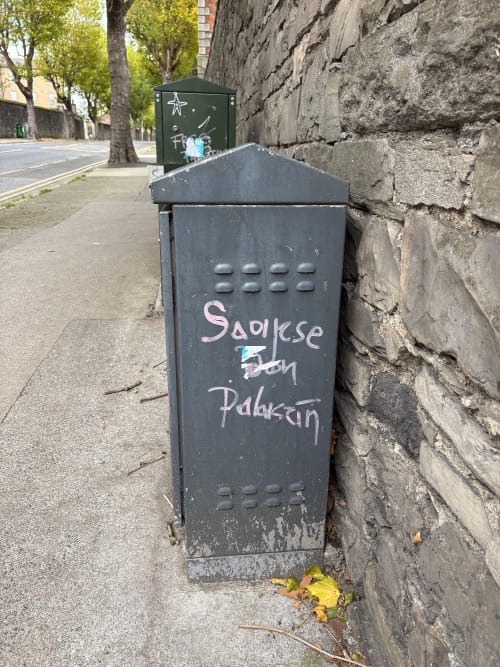
I found myself walking up a street lined with huge sycamores and a mail collection box with "Saoirse don Phalaistín" written in silver marker on its side. A good sign, I thought.
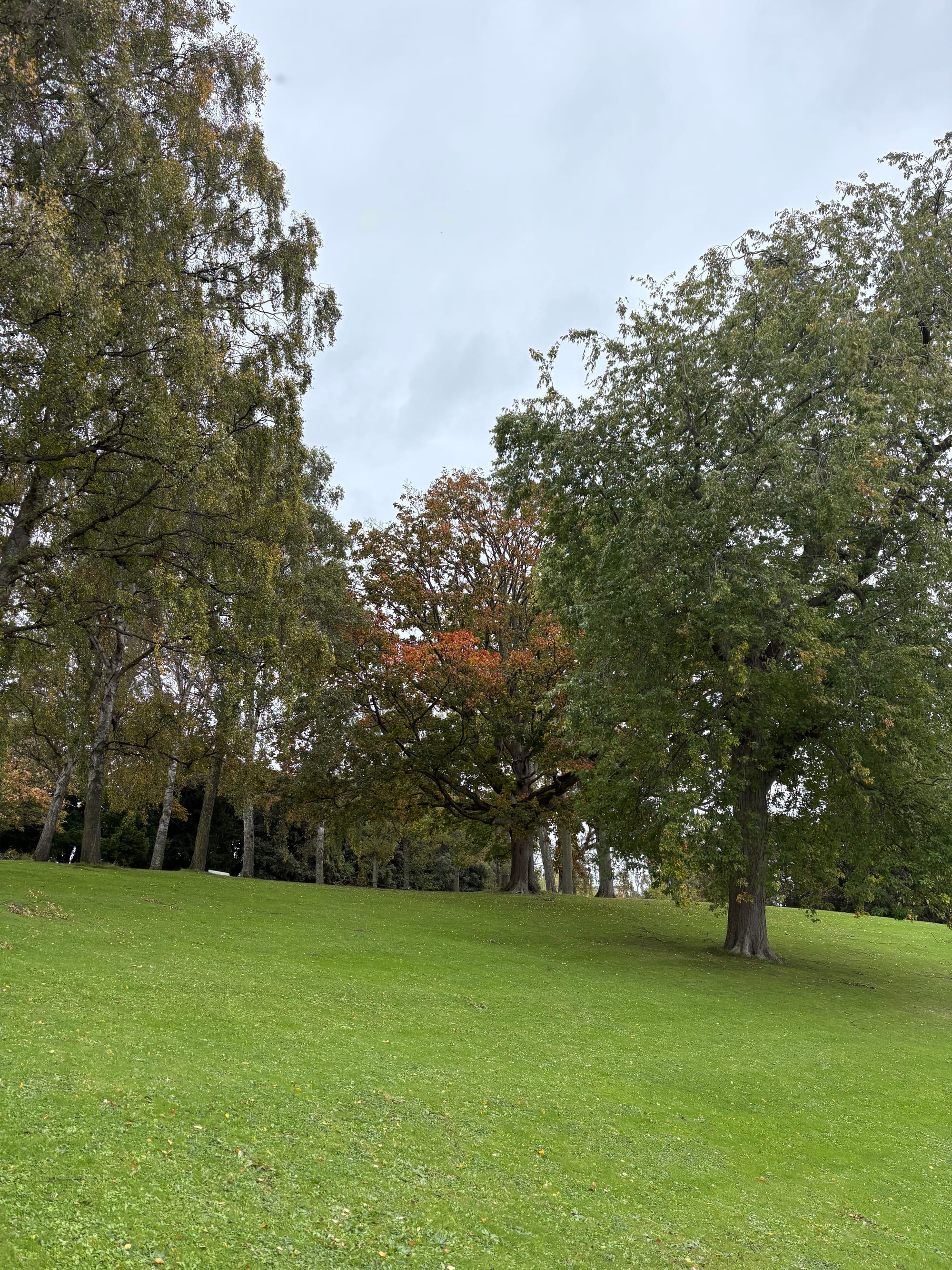
Within minutes I arrived at the gates of a vast, sweeping park, with a pond, and huge chestnut and maple trees, and many other trees I didn't recognize. There was a young man pushing a baby in the stroller and they were chatting to each other, the baby's words unintelligible to me, while he wheezed up the hill.
There was another man taking his two children to harvest chestnuts that had fallen from a huge tree. He handed them plastic grocery bags and they began running toward the tree, delighted. The chestnuts were scattered like dark brown eggs in the grass.
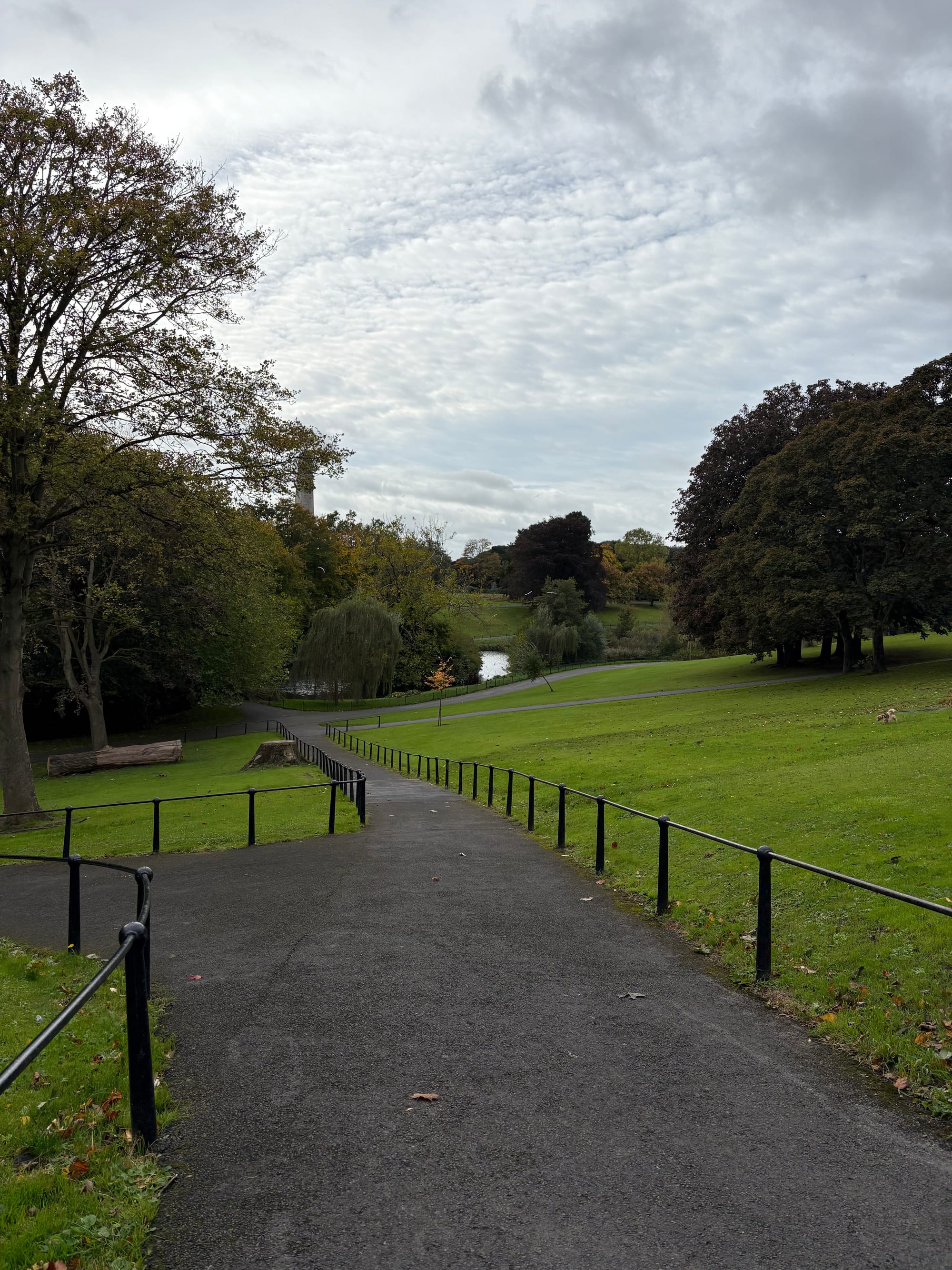
I later learned this park was called Phoenix park – an old Victorian garden by the Dublin zoo. I believe that lawns –in the British colonial style– are an abomination to ecosystems, but I couldn't deny the serenity of a vast expanse of green to walk in.
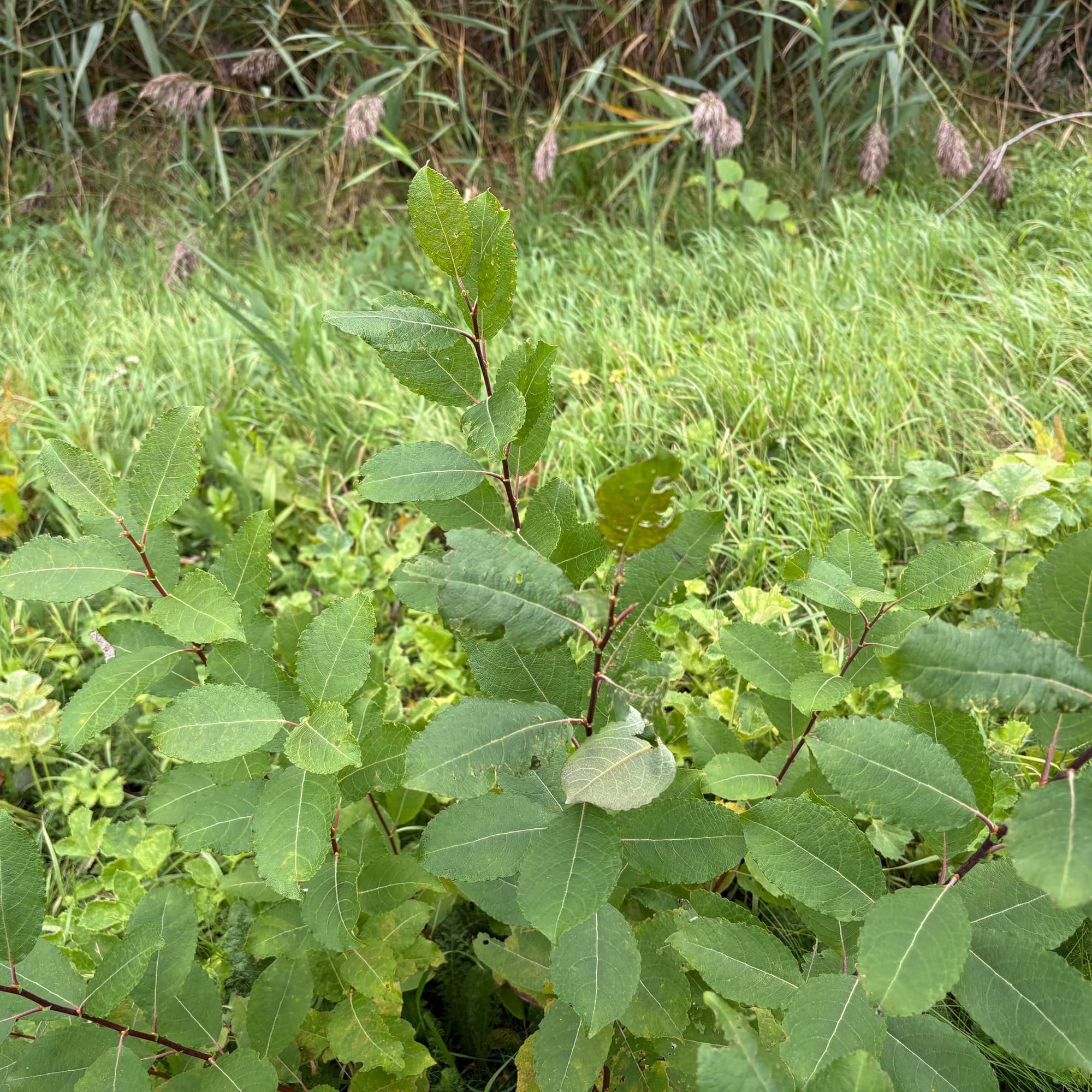
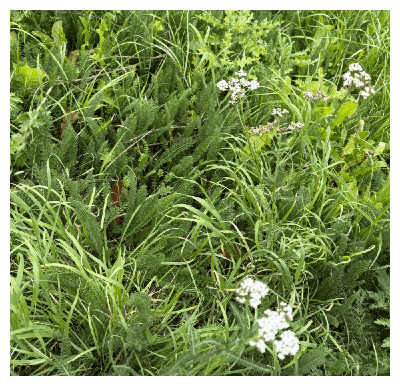
In this park, I saw yarrow, nettle, thistle, and some kind of milkweed. I was taken aback by the familiarity, that these herbs I know so well in North America could grow, have always grown, here on this island. Yarrow, the bitter numbing, and nettle, the sweet stinging. I rubbed my hands along the nettle to make sure it was true– is it you? And by the itchy burning in my fingertips, it certainly was. (Later that night on the train, I would rub my fingers together where they had been stung, and feel like my friend nettle had given me a gift –the gift of prickly sensation– to carry with me.)
It felt like greeting old friends. As someone new to herbalism, but not new to talking to plants, I find myself forgetting the names, but remembering my long ago experiences, of the plants I meet. I wonder if this is true for many of us. I will call plants by where I last met them. "Oh – there's 'smelled-funky-behind-the-fence'!'" or "stained-my-soccer-ball-green-for-a-day'". I wonder if the plants mind this haphazard nomenclature.
There is an ancient Irish myth about the origin of medicinal plants. Airmed. The story goes that a medicine man died, and all the medicinal plants in Ireland grew from his dead body, precisely from the part of the body they could heal. (And what an offering in death, for your body to grow medicine for other bodies to heal. When I die, lay me in a field, and plant some yarrow on my corpse.) But then, through war, or some conflict, the plants were separated and spread out, with their particular uses lost. So the Irish people had to piece back together, through trial and error, which plants correspond to which medicinal purpose in the body. (All plants are medicine, if you really look.) There is a way that this scrambling back together is exactly what I'm doing in learning the names of plants again. It doesn't matter what I call them. But I must try to reciprocate all that they have given us, with such generous anonymity.
On the plane, I was preparing myself to feel immediately disillusioned with Ireland. This trip had come in the wake of a lot of learning and conversation about my Irish ancestors – time spent sitting in the grubby in-between of history, where my people have harmed many people, especially Black and Indigenous people– on U.S. land, and yet brought with them many years of suffering from Ireland.
Part of why the island was so illusive was because my grandfather, born in Death Valley, California, to Irish parents, was not raised to know a lot about Ireland. He retold the same rotation of stories his parents had told him, of life in County Mayo. He liked the Mary Wallopers and the Clancy Brothers. But there was a lot of silence around what it was like to live there. I think because there was also a lot of pain.
I have felt cautious about experiencing joy and awe around Ireland. Part of me feels like I'm grasping too hard for something that is no longer there. And there is truth, that the Ireland my ancestors knew simply doesn't exist anymore. Ireland is itself mired in an upsetting (and ironic) turn toward fascism and xenophobia after decades of private industry that have swallowed the island's economy.
So I told myself, in visiting Ireland for the first time, that I would just let myself feel whatever came, that feeling a disconnect would be its own kind of information. But the truth is– seeing yarrow and nettle, growing up in the "weedy" spaces between lawns and gardens, reminded me of who I am. I was SO GRATEFUL they were there. It reminded me that I literally carry the land I come from in my DNA. And I carry my relationships to plants with me the way I carry my relationships to people. The yarrow whose leaves I used to tickle my arms on bored summer days as a kid. There are unbreakable bonds across time and space that are held through plants. They do the holding for us.
I first remember properly meeting yarrow on a trail crew with the Montana Conservation corps when I was 16. Our leader, Semra, pointed it out to me, and said it could numb cuts and mosquito bites if you muddled the leaves on your skin. I put a leaf in my mouth and felt the gentle numbing creep up the side of my tongue. I was taken aback by its power, held in this soft fern-like leaf. Yarrow, that bitter-tasting leaf that assuages inflammation, that flower of unexpected salvation, of dry buoyancy in Montana wind, that plant you could trust would be around the corner somewhere. Here it was, had always been, not far from where my great-grandparents had lived.
My great-grandparents left west Mayo, got married in the Bronx, and then moved to a railroad town in Death Valley, California. Coming from this verdant, damp, gray-sky land, what could they have made of the sand, the searing sun, the cactuses and sage brush? They could not have respected, much less recognized, the sacredness of the desert where they were. The people who very likely held the knowledge about the sacredness of Death Valley, the Timbisha Shoshone Tribe, were violently displaced. And this is where my memories of plants, the ones I know and the ones I don't, are so tied to the displacement of people I will never meet.
My great-grandparents came to Death Valley as settlers –railroad laborers– because they had very limited options to do otherwise. And yet, they did have options in how they responded to the U.S. system being built around them, in their name. My great-grandfather DID make a choice to assimilate to whiteness to become a railroad foreman in an environment of racist discrimination against his Mexican coworkers and neighbors. This is a choice nobody should have to make, but it is still a choice. It's a choice that me and my family have benefited from materially, but we have lost so much to the lie that material stability alone would protect us. The choices of my great-grandparents are choices I am responsible for. But I am not alone in this responsibility.
Yarrow may very well have been an essential remedy for many ailments – perhaps the ailment of surviving land dispossession. And my great-grandparents, back in Ireland, would have had nobody else but their neighbors for support, when they had to protect their landways from British police and landlords.
Yarrow is called "Athair thalún" in Irish, which means father of the earth. In Ireland, did they turn to yarrow, growing as it does in the mountains around Lough Mask in Co. Mayo? As they survived dispossession on the land they loved and tended to? Did yarrow bring them any peace? Could yarrow –now, perhaps the way a father of the land would– provide an unwavering place from which to face reality?
I may be the great-grandchild of Irish people, people I never knew. But I am also the great-grandchild of yarrow, who I am getting to know every day. Certainly, yarrow has always known me. When I saw the yarrow on that rainy day in Ireland, I couldn't stop saying "hello, hello, hello, oh my god, it's you!"